Beyond AI Detection: What Turnitin's Q2 2026 Learning Integrity Report Means for the Future of Higher Education
Artificial intelligence has fundamentally changed academic writing. The question is no longer "Did a student use AI?" but rather "How can AI be used responsibly while preserving authentic learning?"
Turnitin's Q2 2026 Learning Integrity Insights Report highlights this important transition. Instead of focusing solely on detecting AI-generated content, the report argues that higher education is entering a new era—one where learning integrity becomes the central objective.
For educators, students, and EdTech developers, this report provides valuable insights into how AI is changing assessment, teaching strategies, institutional policies, and student behavior.
This article analyzes the report's key findings and explores what they mean for the future of education.
AI Is No Longer the Biggest Problem—Learning Integrity Is
Traditional plagiarism detection focused on copied content.
Generative AI has changed that completely.
Students can now produce essays, reports, reflections, literature reviews, and even coding assignments within minutes using tools such as ChatGPT, Claude, Gemini, and other large language models.
As a result, academic integrity has become significantly more complicated.
Turnitin argues that institutions should stop treating AI as simply another form of cheating. Instead, AI should be viewed as a permanent component of modern education that requires new teaching methods, assessment models, and institutional policies.
The report therefore introduces a broader framework:
Learning Integrity
Rather than asking:
- Did the student use AI?
Institutions should instead ask:
- Did the student genuinely demonstrate learning?
- Can they explain their reasoning?
- Is the submitted work an authentic reflection of their understanding?
- Was AI used transparently and responsibly?
This represents one of the most significant philosophical shifts in education since generative AI became mainstream.
AI Usage Differs Dramatically Across Countries
One of the report's most interesting findings is that AI adoption is not uniform worldwide.
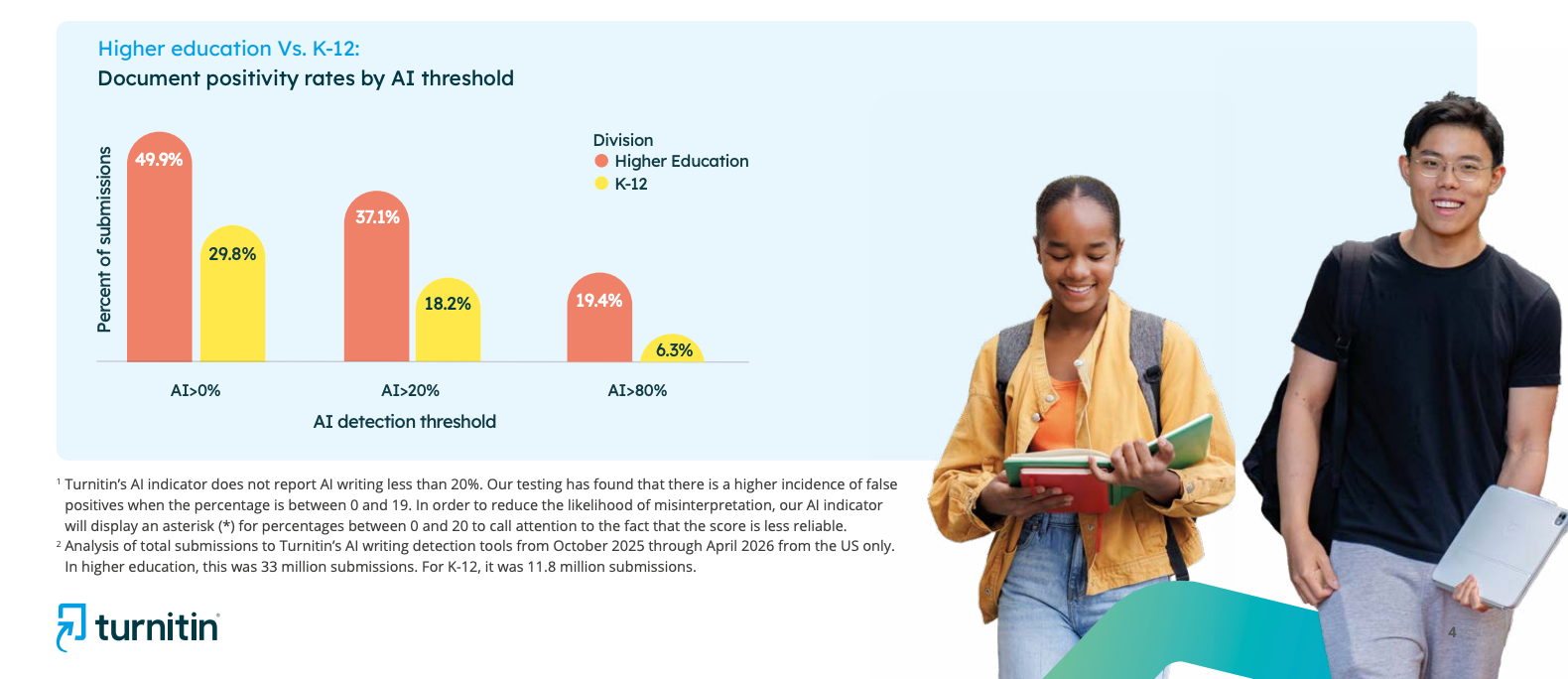
According to Turnitin's data, students in the United States submit substantially more assignments containing extensive AI-generated text than students in the United Kingdom or Australia.
The report identifies a category of submissions where more than 80% of the writing appears AI-generated.
In this category:
- U.S. universities show the highest proportion.
- The percentage is roughly double that observed in the UK and Australia.
- Considerable variation also exists between institutions.
This finding suggests that local educational culture, institutional policy, assessment design, and AI guidance all influence student behavior.
For universities, this means there is no universal solution. Effective AI governance must consider local contexts rather than applying identical rules everywhere.
The Conversation Is Moving Beyond AI Detection
For much of 2023 and 2024, discussions centered on one question:
"How accurately can AI be detected?"
By 2026, the conversation has changed dramatically.
Turnitin's report indicates that educators increasingly recognize the limitations of relying solely on AI detection scores.
Several reasons explain this shift:
AI writing is becoming increasingly human-like
Modern language models produce more natural sentence structures, varied vocabulary, and stronger logical flow than earlier systems.
Detection therefore becomes progressively more difficult.
False positives remain a concern
Educators are cautious about making academic decisions based solely on AI probability scores.
Even highly capable human writers can occasionally produce writing patterns that resemble AI-generated text.
Detection alone cannot improve learning
Knowing whether AI may have been used does not tell instructors:
- whether students understood the material,
- how much critical thinking occurred,
- or what learning actually took place.
The report therefore emphasizes that AI detection should be treated as one piece of evidence, not the final verdict.
Learning integrity emphasizes authentic understanding rather than simply identifying AI-generated content.
Educators Want Teaching Tools—Not Just Detection Tools
One of the strongest themes throughout the report is that educators increasingly expect AI solutions to support teaching instead of merely identifying potential misconduct.
Rather than asking software to answer:
"Was this written by AI?"
many instructors now want answers to questions such as:
- Where is the student's reasoning weakest?
- Which concepts require additional instruction?
- How has writing quality improved over the semester?
- Which students need more academic support?
- How can AI encourage revision rather than replacement?
This shift reflects a broader change in educational priorities.
Teachers are looking for technologies that promote learning outcomes, provide meaningful feedback, and strengthen critical thinking—not simply flag suspicious text.
For EdTech companies, this represents a major opportunity. The future of academic AI tools will likely combine writing analytics, formative feedback, revision tracking, and instructional insights alongside traditional integrity checks.
Why Assessment Design Matters More Than Detection
The report also emphasizes that assessment design plays a critical role in maintaining academic integrity.
Assignments that require personal reflection, iterative drafts, oral explanations, real-world applications, or documented research processes are inherently more resistant to misuse of generative AI.
Instead of relying solely on detection systems, institutions are increasingly redesigning coursework so that authentic learning becomes easier to demonstrate and harder to outsource.
AI Governance Is Moving Into the Classroom
One of the most significant insights from Turnitin's report is that responsibility for AI governance is shifting.
During the early adoption of generative AI, universities primarily relied on central IT departments to establish institutional policies. These teams evaluated AI platforms, managed security concerns, and created broad usage guidelines.
However, this model is no longer sufficient.
Every discipline uses AI differently:
- A computer science professor may encourage students to use AI for debugging code.
- A journalism instructor may prohibit AI-generated reporting.
- A business school may require students to disclose AI assistance.
- A creative writing course may limit AI usage to brainstorming only.
Because learning objectives differ across subjects, faculty members—not IT departments—are increasingly making the final decisions about acceptable AI use.
Turnitin describes this as a transition toward educator-led AI governance, where instructors define expectations based on pedagogical goals rather than applying one universal policy.
This shift gives educators greater flexibility while encouraging more meaningful conversations about responsible AI use.
AI Literacy Is Becoming a Core Academic Skill
Several years ago, universities focused on digital literacy—teaching students how to search for information, evaluate online sources, and avoid plagiarism.
Today, AI literacy is rapidly becoming the next essential competency.
According to the report, AI literacy is not simply learning how to write better prompts. Instead, it includes a much broader set of abilities:
- Understanding AI's strengths and limitations.
- Recognizing hallucinations and factual inaccuracies.
- Verifying AI-generated information using reliable sources.
- Citing AI tools appropriately when required.
- Critically evaluating AI suggestions rather than accepting them automatically.
- Maintaining independent reasoning throughout the writing process.
Students who rely entirely on AI may complete assignments more quickly, but they often miss opportunities to develop analytical thinking, research skills, and subject expertise.
Universities therefore face a new challenge: teaching students how to collaborate with AI without becoming dependent on it.

Future classrooms will emphasize AI literacy, critical thinking, and collaborative learning rather than simply prohibiting AI tools.
Assessment Is Being Redesigned for the AI Era
One of the report's strongest messages is that assessment—not detection—will determine the future of academic integrity.
Traditional essays written outside the classroom are increasingly vulnerable to extensive AI assistance.
As a result, many institutions are experimenting with new assessment formats that make authentic learning more visible.
Examples include:
Draft-Based Writing
Instead of submitting only a final essay, students submit:
- Brainstorming notes
- Outlines
- First drafts
- Peer feedback
- Revision history
- Final reflection
This process demonstrates how ideas developed over time.
Oral Explanations
Students may be asked to explain:
- Why they chose certain evidence.
- How they evaluated sources.
- Why they revised specific paragraphs.
- What role AI played during drafting.
Even if AI assisted with writing, genuine understanding becomes much easier to evaluate through discussion.
Authentic Projects
Many universities are replacing purely theoretical assignments with:
- Case studies
- Industry projects
- Personal reflection
- Local community research
- Group collaboration
These assessments require contextual knowledge that generic AI responses often cannot provide effectively.
AI Detection Is Becoming Part of a Larger Ecosystem
A common misconception is that AI detection tools will disappear.
Turnitin's report suggests the opposite.
Detection will remain valuable—but as one component within a broader learning ecosystem.
Future academic integrity platforms may combine:
- AI writing indicators
- Similarity reports
- Draft history
- Revision timelines
- Citation analysis
- Writing process analytics
- Instructor observations
- Classroom participation
- Learning management system data
Instead of producing a single percentage score, these systems will offer educators a richer picture of how students learn and write.
This represents a shift from content analysis to learning evidence.
Future academic integrity platforms are expected to evaluate the writing process—not just the final submission.
What This Means for Students
Students often ask one question:
"How can I avoid being detected as AI-generated?"
The report suggests that this is the wrong question.
A better question is:
"How can I use AI responsibly while demonstrating my own learning?"
Students should aim to:
- Use AI for brainstorming rather than replacing original thinking.
- Verify every factual claim produced by AI.
- Add personal analysis instead of relying on generic explanations.
- Revise AI-generated drafts using their own voice.
- Follow institutional disclosure requirements.
- Keep notes or drafts that demonstrate their learning process.
Ultimately, authentic engagement with the material is far more valuable than trying to optimize an AI detection score.
What This Means for Educators
For instructors, the report encourages a shift in mindset.
Instead of viewing AI solely as a disciplinary challenge, educators can leverage it as a teaching opportunity.
Some practical strategies include:
- Redesign assignments to emphasize critical thinking.
- Require multiple drafts and revision reflections.
- Incorporate oral presentations or discussions.
- Teach students how to evaluate AI-generated information critically.
- Clearly communicate acceptable and unacceptable AI use.
- Use AI detection reports as conversation starters rather than final judgments.
When students understand why integrity matters, they are more likely to engage ethically with AI tools.
Opportunities for EdTech Companies
The report also has important implications for educational technology providers.
Rather than building products that only answer:
"Is this AI?"
The next generation of learning platforms should help answer questions such as:
- How has a student's writing evolved?
- Where does the student need targeted support?
- Which concepts remain misunderstood?
- What evidence demonstrates authentic learning?
- How can instructors provide timely formative feedback?
Companies that integrate AI assistance, learning analytics, revision tracking, and integrity support into a single workflow are likely to shape the future of educational technology.
Key Takeaways
Turnitin's Q2 2026 Learning Integrity Insights Report highlights several important trends:
- Academic integrity is evolving into learning integrity.
- AI detection remains useful but is no longer the primary objective.
- AI literacy is becoming an essential graduate skill.
- Assessment design plays a greater role than detection technology.
- Faculty members are increasingly leading AI governance.
- Future educational platforms will evaluate the learning process, not just final outputs.
- Responsible AI use depends on transparency, critical thinking, and authentic student engagement.
Final Thoughts
Turnitin's Q2 2026 report makes one thing clear:
The future of education will not be defined by a race between increasingly sophisticated AI models and increasingly sophisticated detection systems.
Instead, success will depend on how effectively educators redesign learning experiences, how responsibly students integrate AI into their work, and how institutions cultivate a culture of integrity.
AI is no longer an external challenge to education—it has become part of education itself.
The real question is no longer whether students use AI, but whether AI is helping students learn.
Frequently Asked Questions
Is Turnitin moving away from AI detection?
Not entirely. The report suggests that AI detection will continue to play an important role, but as one piece of evidence within a broader learning integrity framework rather than as a standalone judgment.
What is Learning Integrity?
Learning integrity focuses on whether submitted work genuinely reflects a student's understanding, reasoning, and learning process. It extends beyond plagiarism and AI detection to emphasize authentic educational outcomes.
Why is AI literacy becoming important?
Because AI tools are now widely available, students need to know how to evaluate AI-generated information, verify facts, cite AI appropriately, and use these technologies ethically without replacing independent thinking.
Will AI replace traditional essays?
Not necessarily. However, universities are increasingly redesigning assessments to include drafts, reflections, presentations, project-based work, and other formats that better demonstrate authentic learning.
Conclusion
The Q2 2026 Learning Integrity Insights Report marks a turning point in higher education. Rather than framing AI as an adversary, it encourages institutions to rethink assessment, strengthen AI literacy, and focus on evidence of learning instead of merely evidence of AI use.
For educators, students, and EdTech innovators alike, the message is clear: the future belongs to those who can combine technological innovation with genuine human learning.