The Complete Guide to Turnitin AI Detection in 2026: How It Works, AI Scores, Reports, Accuracy, and Best Practices
The landscape of academic integrity has undergone a dramatic transformation since generative AI tools entered the mainstream. As of 2026, Turnitin AI Detection has become the cornerstone of integrity verification at over 16,000 educational institutions worldwide. Whether you're a student submitting your first assignment, an educator reviewing submissions, or an administrator establishing institutional policies, understanding how Turnitin detects AI-generated content is no longer optional—it's essential.
This comprehensive guide serves as your definitive resource for everything related to Turnitin's AI detection capabilities. From the underlying technology to practical interpretation of scores, from accuracy limitations to comparison with other tools, we cover every aspect you need to navigate the complex intersection of AI writing and academic integrity.
What Is Turnitin AI Detection?

Turnitin AI Detection is an advanced writing analysis feature integrated directly into Turnitin's established plagiarism detection platform. Launched in April 2023, this technology was developed specifically to address the growing prevalence of AI-generated content in educational settings. Unlike traditional plagiarism checks that identify copied or improperly cited material, Turnitin's AI detection analyzes the statistical patterns within text to determine whether content was likely produced by a human writer or generated by a large language model (LLM).
The system can identify text produced by major AI tools including ChatGPT (including GPT-4 and GPT-5), Claude, Gemini, and various other LLMs that students might use to assist with assignments. Importantly, Turnitin distinguishes between two categories: AI-generated text (content created directly by an AI system) and AI-paraphrased text (content that was first generated by AI and then run through a paraphrasing tool).
This distinction matters because it reflects the complexity of how students actually use AI tools. Some might copy AI-generated paragraphs directly, while others might use AI to rephrase their own ideas or to rewrite existing content in a different style. Turnitin's technology attempts to capture this entire spectrum of AI-assisted writing.
The detection model operates continuously, with Turnitin releasing regular updates to improve accuracy and address new AI writing tools. According to their official release notes, significant updates occurred in May 2026, February 2026, and throughout 2025, demonstrating Turnitin's commitment to keeping pace with rapidly evolving AI technology.
Read our complete guide: What Is Turnitin AI Detection?
How Turnitin AI Detection Works: The Technical Foundation

Understanding the technical mechanisms behind Turnitin's AI detection helps both students and educators interpret results accurately. At its core, the system analyzes two key linguistic metrics: perplexity and burstiness.
Perplexity measures how predictable a piece of text is. Human writers tend to produce text with varying levels of predictability—sometimes using common phrases, other times introducing unexpected word choices or sentence structures. AI language models, conversely, typically generate text with consistently low perplexity because they optimize for statistically probable language patterns.
Burstiness refers to the variation in sentence length and structure. Human writing naturally exhibits high burstiness, with a mix of short, punchy sentences and longer, more complex ones. AI-generated text tends toward uniformity, producing sentences of similar length with comparable structural patterns.
Turnitin's detection model was trained on vast datasets of both human-written and AI-generated content. The system analyzes documents at multiple levels—examining individual sentences, paragraphs, and the overall document structure—to identify patterns consistent with AI generation.
A significant technical advancement came with Turnitin's bypasser detection, added in August 2025 and further improved in February 2026. This feature specifically targets text that has been processed through AI paraphrasing tools like QuillBot, which some students attempt to use to evade detection. The system can now identify characteristic patterns left behind by such tools, even when the text has been significantly modified.
It's worth noting that Turnitin's AI detection operates independently from its similarity scoring. While the similarity report highlights potentially plagiarized content, the AI writing indicator focuses exclusively on generation patterns. Both reports appear in the same interface but measure different aspects of content authenticity.
Read our complete guide: How Turnitin Works: Technical Deep Dive
Understanding Turnitin AI Score: What the Percentages Mean

When you submit a document to Turnitin, the AI writing indicator displays a percentage from 0% to 100%. This Turnitin AI percentage represents the proportion of your submission that the system estimates was likely generated by an AI tool. However, interpreting this number requires understanding several important nuances.
Scores below 20% receive special treatment. Turnitin intentionally hides the exact percentage for submissions in this range, displaying only an asterisk (*) instead. This is because scores in this range are considered within normal variation and may simply reflect the use of common writing templates, formal academic language, or other factors that don't indicate AI use.
A Turnitin AI score of 20-50% suggests moderate indicators of AI generation. This doesn't automatically mean academic misconduct—it indicates that certain passages warrant instructor review. Students in this range might consider revising their work to ensure authentic voice is evident throughout.
Scores of 51-75% indicate significant AI indicators. Submissions in this range are more likely to contain substantial AI-generated content, though false positives remain possible, particularly for non-native English speakers whose writing patterns may superficially resemble AI patterns.
Scores above 75% suggest heavy AI involvement. Such high percentages typically indicate that most or all of the document was generated by AI, though educators should still consider context and individual circumstances.
The AI writing score is calculated separately from the similarity score—they measure different things and don't directly correlate. A document with low similarity might have high AI indicators, and vice versa. Turnitin's documentation emphasizes that neither score alone proves misconduct; professional judgment remains essential.
Read our complete guide: Turnitin AI Score Explained: Complete Breakdown
Reading the Turnitin AI Report: A Practical Guide
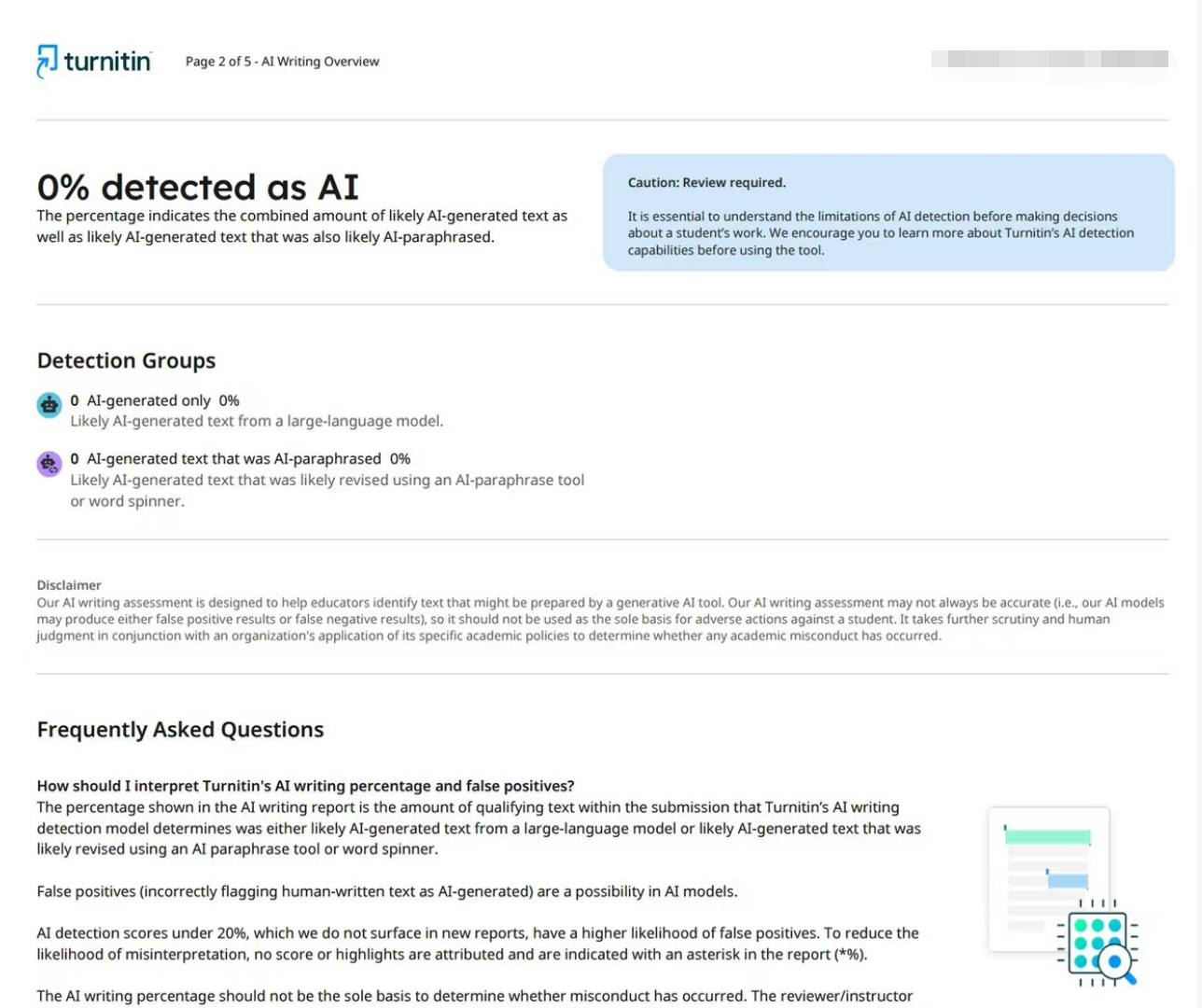
The Turnitin AI Report provides visual feedback on which portions of a submission may have been AI-generated. Understanding how to read this report is crucial for both educators making assessment decisions and students wanting to verify their work.
After processing a submission, Turnitin highlights specific text passages in the document viewer. These highlighted sections indicate content that the detection model has identified as likely AI-generated. The highlighting appears in varying intensities, suggesting the system's confidence level for each passage.
The report divides the AI writing score into two categories: AI-generated text and AI-paraphrased text. This distinction helps reviewers understand whether the flagged content was created directly by an AI tool or whether it was first AI-generated and then processed through a paraphrasing application.
For educators, Turnitin provides guidance on reviewing the AI writing report. The recommended approach involves:
- Reviewing the overall percentage as a starting point for investigation
- Examining highlighted passages in context with surrounding content
- Considering individual student factors including writing history and language background
- Using professional judgment rather than treating scores as definitive proof
Turnitin explicitly acknowledges that false positives occur, particularly in the 0-19% range where detection confidence is lowest. Their official guidance states that educators must apply professional judgment, knowledge of individual students, and specific assignment context when interpreting results.
Students who see unexpected AI indicators should review the highlighted passages and consider whether certain writing patterns might have triggered the detection. Common causes of false positives include heavily structured templates, formal academic language, and text written under time pressure using unconventional methods.
Read our complete guide: Turnitin AI Report Guide: Complete Interpretation
Turnitin AI Accuracy: Separating Fact from Fiction

Turnitin AI accuracy remains one of the most debated aspects of the platform. Turnitin claims a 98%+ accuracy rate on documents where more than 20% of content is AI-generated, with a published false positive rate under 1%. However, independent research paints a more complex picture.
Several studies have challenged these claims. A Washington Post investigation found false positive rates as high as 50% in some scenarios, though this research used a smaller sample size than Turnitin's internal testing. More recent independent analyses suggest real-world detection accuracy typically ranges between 60-85% for edited AI text, dropping significantly when students employ paraphrasing tools or make manual edits.
The accuracy varies considerably based on several factors:
AI Model Used: Turnitin detects different AI models with varying effectiveness. Research indicates approximately 96% detection accuracy for Claude output and 97% for Gemini content. Newer models with more human-like writing patterns may achieve lower detection rates.
Editing and Modification: Unmodified AI output is easiest to detect. When students paraphrase AI content, use text humanizers, or make manual edits, detection accuracy decreases substantially.
Document Length: Longer documents with varied content provide more data points for analysis, generally improving accuracy. Short submissions may produce less reliable results.
Language Background: Studies consistently show higher false positive rates for non-native English speakers. The formal, structured writing patterns common among these students can superficially resemble AI-generated text.
Several major universities, including institutions at Curtin, Vanderbilt, and various UC campuses, have raised concerns about AI detection reliability and implemented additional review procedures. This institutional caution reflects the technology's current limitations.
Turnitin maintains that no detection system is perfect and explicitly states that results should be reviewed alongside other evidence and professional judgment. Their recent updates have focused on reducing false positives and improving detection of paraphrased content.
Read our complete guide: Turnitin Accuracy: Comprehensive Analysis
Turnitin False Positives: Understanding the Problem

Turnitin false positives occur when the system incorrectly identifies human-written content as AI-generated. This issue has become one of the most significant concerns surrounding AI detection technology in education, with implications for student fairness, academic standing, and institutional liability.
Turnitin officially acknowledges that false positives happen and maintains that scores should never be used as sole evidence of academic misconduct. Their guidance emphasizes that instructors must apply professional judgment and consider individual student circumstances before drawing conclusions.
Several factors contribute to false positive detections:
Writing Style Characteristics: Students who write in a highly formal, structured manner may trigger AI detection indicators. Academic conventions often encourage impersonal language, logical organization, and consistent tone—all characteristics that AI models also tend to produce.
Neurodivergent Students: Research indicates that students with autism, ADHD, or dyslexia may experience higher false positive rates. The unique cognitive approaches these students bring to writing can produce patterns that resemble AI generation.
Time Pressure: Writing completed under significant time constraints may produce text with unusual characteristics. The stress and efficiency focus of timed essays can result in patterns that differ from natural, unhurried writing.
Language Transfer: Non-native English speakers may write in patterns influenced by their first language. These transfer effects can create text characteristics that superficially match AI detection patterns.
The consequences of false positives extend beyond individual cases. Students falsely accused of AI misuse may face academic penalties, emotional distress, and damage to their academic record. Institutions may face legal challenges and reputational harm.
Turnitin has released specific guidance for educators on handling potential false positive scenarios, including recommendations for conversations with students and procedures for appeal. However, the fundamental challenge remains: current detection technology cannot definitively distinguish between AI-generated and certain types of human-written content.
Read our complete guide: Turnitin False Positives: Causes and Solutions
Turnitin vs GPTZero: Comparing AI Detection Tools

When evaluating Turnitin vs GPTZero, educators and students often want to understand which tool offers superior detection capabilities. Both platforms represent the leading approaches to AI detection in education, but they serve somewhat different markets and use cases.
Turnitin operates primarily at the institutional level, integrating directly into learning management systems (LMS) like Canvas, Blackboard, and Moodle. It's the established standard for academic integrity checking, with AI detection added to its existing plagiarism platform. This integration means that for many students and instructors, Turnitin is simply part of the submission process rather than a separate tool to use.
GPTZero was developed specifically for AI detection and targets both institutional and individual users. It offers more transparent pricing and accessibility for those without institutional subscriptions. GPTZero has gained popularity among individual teachers and smaller institutions looking for dedicated AI detection capabilities.
Regarding accuracy, independent comparisons suggest similar performance levels, though results vary by content type. Turnitin's larger training dataset and institutional testing provide some advantages, while GPTZero's focused development on detection technology offers flexibility and rapid updates.
Both tools have similar limitations: neither can definitively prove AI usage, both produce false positives, and detection effectiveness decreases with heavily edited AI content. The choice between them often depends more on institutional context, budget, and integration requirements than on raw detection capability.
Turnitin's recent addition of bypasser detection gives it an advantage against paraphrasing tools, while GPTZero has pioneered features like paragraph-level analysis and writing improvement suggestions.
Read our complete guide: Turnitin vs GPTZero: Comprehensive Comparison
Can Turnitin Detect ChatGPT, Grammarly, Claude, and Gemini?

This is one of the most frequently asked questions about Turnitin's capabilities, and the answer has evolved significantly throughout 2025 and 2026.
Can Turnitin detect ChatGPT? Yes. Turnitin detects ChatGPT-generated content, including text from GPT-3.5, GPT-4, and GPT-5. Detection rates for unmodified ChatGPT output are very high, approaching the accuracy figures Turnitin publishes. However, detection becomes more challenging when students edit, paraphrase, or use ChatGPT in combination with their own writing.
Can Turnitin detect Grammarly? This question requires nuance. Grammarly itself is primarily a grammar and style checker, not an AI text generator. However, Grammarly does offer AI-assisted writing features. Turnitin cannot specifically detect Grammarly usage, but it can potentially detect content that Grammarly's AI features generated. Standard Grammarly usage for grammar checking doesn't typically trigger AI indicators.
Can Turnitin detect Claude? Research testing indicates approximately 96% detection accuracy for Claude-generated content. Anthropic's Claude produces highly polished, human-like prose, which can make detection more challenging than for some other models. However, Turnitin's continuous updates have improved detection rates for Claude across 2025 and 2026.
Can Turnitin detect Gemini? Google Gemini content is detected at approximately 97% accuracy, one of the highest rates among major AI models. Gemini has become the second most popular AI tool among students, and Turnitin's detection engine specifically targets Gemini output.
Can Turnitin detect paraphrasing tools? With the bypasser detection updates in August 2025 and February 2026, Turnitin now catches basic paraphrasing tools like QuillBot. However, sophisticated human editing or advanced text humanizers may still evade detection.
Read our complete guide: Can Turnitin Detect ChatGPT, Claude, and Gemini?
Best Practices for Students and Educators

For students navigating the landscape of AI detection, understanding best practices helps ensure your work is properly represented and avoids unnecessary complications.
For Students:
-
Understand your institution's policies. AI usage policies vary significantly between institutions and even between courses. Before starting any assignment, clarify what AI assistance is permitted.
-
Use AI as a tool, not a writer. AI can help with brainstorming, outlining, grammar checking, and research assistance. However, the final submitted work should primarily reflect
Explore More Turnitin Guides
- What Is Turnitin AI Detection?
- Turnitin AI Score Explained
- Turnitin AI Report Guide
- Turnitin False Positives
- Turnitin AI vs Similarity
- Turnitin Review
- Turnitin AI Updates
- Turnitin Accuracy
- Turnitin vs GPTZero
- Can Turnitin Detect ChatGPT?
- Can Turnitin Detect Grammarly?
- Can Turnitin Detect Claude?
- Can Turnitin Detect Gemini?
- Can Turnitin Detect GPT-5?
- How to Appeal a Turnitin AI Flag
Start Checking Before You Submit
Before submitting your assignment, run an AI detection scan with PaperCheck to identify AI-generated sections, review writing consistency, and make informed revisions. Use the result as a private editing signal—not as a shortcut or a promise of any institution's outcome. Check your sources, confirm your citations, make sure the analysis reflects your own understanding, and follow your course's AI policy.